 me
 en
 ru


Why is psychological health a key topic today?
The modern work environment is changing faster than ever. Pressure, more complex tasks, rapid technological change and rising expectations are creating new challenges for employees.
That is why mental health is no longer a private matter for the individual, but a strategic issue for every organisation.
As Aristotle said, “The aim of work is to gain leisure”, and it is psychological well-being that gives people the capacity to live both their free time and their working time well.
Organisations that build care for the psychological safety and well-being of their employees into their processes lay the foundations of a genuine business culture: one in which people work without fear, in an atmosphere of trust and mutual support.
What makes up psychosocial risk?
Psychosocial risks arise when work is organised or managed in a way that has a negative effect on employees’ emotional health.
They can be internal or external factors; read on to see how they are divided.
Internal factors:
- unclearly defined responsibilities,
- conflicts within the team,
- work overload or insufficiently challenging work,
- poor communication and mistrust,
- lack of autonomy at work,
- unfair reward and promotion systems.
External factors:
- pressure from clients,
- market changes,
- technological stress,
- remote work without adequate support.

Psychosocial risks are not visible at first glance, but they leave serious consequences such as burnout, stress, anxiety, loss of motivation, more mistakes and absences from work.
Why is caring for psychological health in the interest of business?
Companies that actively work to improve their employees’ psychological health gain clear benefits, such as:
- less sick leave and absence from work,
- higher productivity and quality of work,
- greater employee loyalty,
- lower staff turnover,
- a better employer reputation.
Numerous studies show that companies that care about the inner well-being of their employees achieve up to 20-25% better business performance.
The renowned psychologist Abraham Maslow pointed out that people can reach their full potential only once their basic needs for safety and belonging are met.
That is exactly why building a culture that fosters psychological well-being is the foundation of every successful organisation.
Recognising the warning signs is the first step towards prevention
Companies need to develop the ability to recognise the early signs of psychosocial problems, which often include:
- chronic stress,
- emotional exhaustion,
- withdrawal from communication,
- reduced concentration,
- an increased number of mistakes at work,
- aggressive behaviour,
- repeated complaints about the work environment.
Timely action prevents more serious consequences and makes for a healthier work environment.
Practical measures employers can take
As an HR coordinator, I advise employers to implement the following measures to create a culture of psychological and emotional well-being for their employees.
Clear roles and responsibilities
Every employee must know what is expected of them. Ambiguity creates stress and insecurity.
A culture of open communication
Employees should feel that they can raise concerns without fear of consequences.
Training for managers
Managers should know how to recognise stress, handle difficult conversations and build a supportive culture.
Work-life balance
Flexible working hours, the right to rest and an even workload are key factors.
Employee support programmes
Psychological counselling, stress management workshops, coaching and other programmes contribute to the health of the whole team.
Regular assessment of psychosocial factors
Periodic analyses of the work climate and well-being enable continuous improvement of the business culture.
The role of Institute SIGURNOST in building a healthy work environment
Institute SIGURNOST recognises that employee health is not a luxury but a standard of modern business.
Through education, counselling, management training, procedure development and the improvement of occupational safety and health systems, the Institute helps companies build workplaces that are:
- safe,
- stable,
- motivating,
- productive,
- sustainable.
Investing in employee health should not be seen as a cost, but as the most profitable long-term investment in people, the organisation and the future.
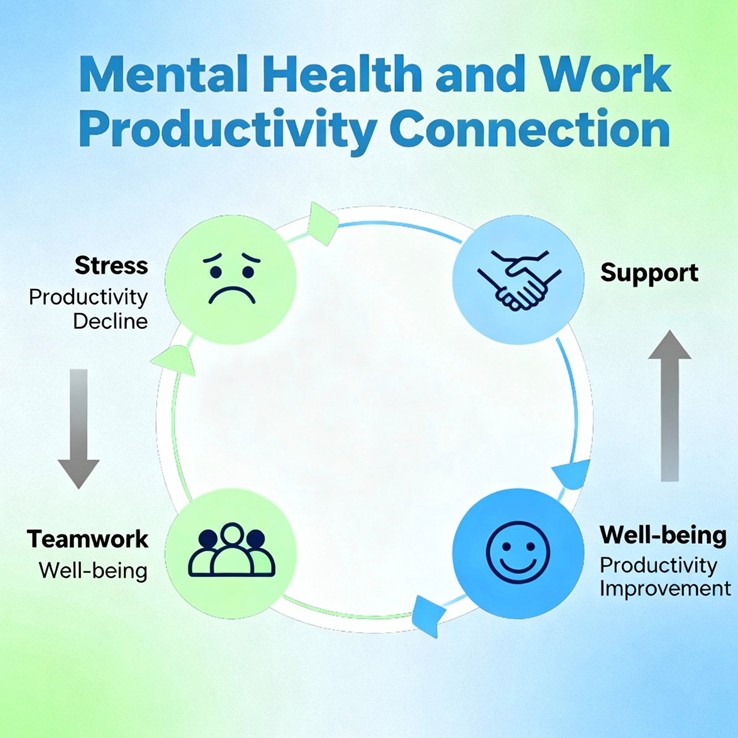
Caring for employees increases company productivity
Organisations that recognise the importance of mental well-being and actively work to reduce psychosocial risks create an environment in which people feel supported, motivated and valued.
As Carl Jung said:
“A healthy person is not one who does not suffer, but one who knows how to cope with suffering.”
Caring for employee health is not only an ethical obligation, but an investment in the resilience, productivity and long-term sustainability of every organisation.

Nataša Pajović, MSc in Economics
Profit Centre Manager and HR Coordinator